Indoor air can change fast, and the best monitor should make those changes easy to see, log, and act on. If you want a home air quality monitor with app display, the right model can track pollutants, send alerts, and help you spot problem rooms before they affect comfort.
In this roundup, we focus on app-connected monitors that balance accuracy, useful sensors, and everyday convenience for home use.
Best 10 Home Air Quality Monitor with App Display Picks for 2026
Fast-Refresh Smart Monitor
GoveeLife Air Quality Monitor with LED Display

- 2-second refresh for PM2.5, temp, and humidity
- LED display plus app monitoring and data export
- Automates compatible GoveeLife air devices
Best For: Users who want fast, simple indoor air tracking with Govee automation
Alexa-Ready Air Monitor
Amazon Smart Air Quality Monitor

- Tracks PM2.5, VOCs, CO, humidity, and temperature
- Shows air quality in the Alexa app with LED status
- Works with Alexa alerts and routines
Best For: Alexa users who want app-based monitoring and simple automation
Portable CO2 Data Monitor
Aranet4 Home Wireless Air Quality Meter

- Wireless monitor with e-ink screen and long battery life
- Tracks CO2, temperature, humidity, and pressure
- App includes graphs and 90 days of history
Best For: Portable CO2 monitoring with long battery life and app history
Pro-Grade Multi-Sensor Monitor
BREATHE Airmonitor Plus with App

- Tracks CO2, PM1/2.5/10, TVOC, HCHO, temp, and humidity
- App alerts plus 30-day history for trend tracking
- Compact corded design with built-in calibration tools
Best For: Users wanting detailed multi-pollutant monitoring and app alerts
Smart CO2 Display Monitor

- Tracks CO2, temperature, humidity, and clock on one screen
- App alerts plus buzzer and email warnings
- 24/7 corded operation with historical data export
Best For: Sleep-focused rooms and offices needing app-connected CO2 monitoring
All-In-One IAQ Monitor
AprilAire Smart 5-in-1 Monitor
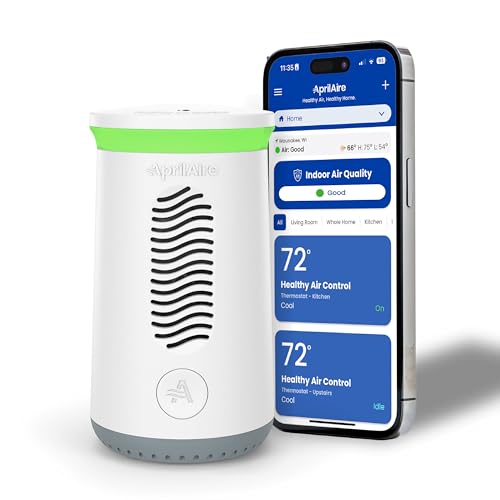
- Measures CO2, VOCs, PM2.5, humidity, and temperature
- Healthy Air App adds alerts, trends, and tips
- Supports AprilAire filtration and ventilation integration
Best For: Families wanting broad IAQ monitoring and app-guided recommendations
Matter Smart Particle Monitor

- Displays PM2.5, PM10, temperature, and humidity
- Matter-compatible for major smart-home platforms
- App, sound, and LED alerts with 12 months of data
Best For: Smart-home setups focused on particulate monitoring and app alerts
Whole-Home WiFi Monitoring
Smart Air Quality Monitor Indoor, WiFi Air Quality Tester

- Tracks AQI, CO2, PM2.5, TVOC, HCHO, temperature, and humidity.
- Connects to Smart Life and Tuya Smart for app-based remote monitoring.
- Wall-mountable design with HD display and 3000mAh battery.
Best For: Families needing broad indoor air monitoring with phone access
Quiet App-Connected Monitor

- Measures CO2, PM2.5, TVOC, temperature, and humidity.
- Temtop app adds history, calibration, and OTA updates.
- E-ink screen and efficient design offer up to 60 days of battery life.
Best For: Bedrooms and offices needing quiet, long-lasting monitoring
Feature-Rich Dual-Chip Monitor
18-in-1 Smart Air Quality Monitor

- Tracks AQI, CO2, PM2.5, PM1.0, PM10, TVOC, HCHO, temp, and humidity.
- Works with Smart Life and Tuya Smart for app data storage and control.
- Dual-chip design and HD LCD aim for fast, stable readings.
Best For: Shoppers wanting the most detailed app-connected indoor monitoring
Fast-Refresh Smart Monitor – GoveeLife Air Quality Monitor with LED Display
If you want a home air quality monitor with app display that prioritizes quick updates, the GoveeLife H5106 is built around PM2.5, temperature, and humidity tracking with a 2-second refresh rate. Its LED display and remote viewing through Bluetooth or Wi‑Fi make it useful for checking conditions at a glance or reviewing trends over time.
Best For: Home and office users who want fast PM2.5 updates, basic indoor air tracking, and Govee smart-home automation.
Pros:
- Tracks PM2.5, temperature, and humidity with 2-second updates.
- Includes LED display, app access, and online data graphs with up to 2 years of exportable history.
- Can trigger compatible GoveeLife purifiers, humidifiers, and fans automatically.
- Switchable bright screen and night mode help it fit different rooms.
Cons:
- Requires a wired Type-C power connection; no built-in battery.
- 2.4G Wi‑Fi is required to display the time.
- Works with selected GoveeLife devices rather than a broad smart-home ecosystem.
Overall, this is a practical pick if you want quick air-quality feedback and app-based history without paying for more advanced gas sensing. It is strongest as a simple, responsive monitor for everyday home or office use.
Alexa-Ready Air Monitor – Amazon Smart Air Quality Monitor
The Amazon Smart Air Quality Monitor is a strong fit if you want a home air quality monitor with app display and you already use Alexa. It tracks PM2.5, VOCs, CO, humidity, and temperature, then shows a color-coded LED on the device while giving you an air quality score and details in the Alexa app.
Best For: Alexa households that want simple setup, app alerts, and automation tied to indoor air changes.
Pros:
- Measures five key factors: PM2.5, VOCs, CO, humidity, and temperature.
- Provides a color-coded LED and detailed air quality score in the Alexa app.
- Sends phone notifications and Echo announcements when air quality drops.
- Supports Alexa Routines to control purifiers, dehumidifiers, fans, and more.
Cons:
- Best suited for users already invested in Alexa.
- Requires a plug-in power source.
- Does not list as many historical data features as some app-focused competitors.
For Alexa users, this monitor keeps setup easy while covering the most practical indoor air metrics. It is a convenience-first choice for turning air-quality readings into automated responses.
Portable CO2 Data Monitor – Aranet4 Home Wireless Air Quality Meter
If you are shopping for a home air quality monitor with app display and want a portable, battery-powered option, the Aranet4 Home stands out for CO2-centric monitoring. It shows CO2, temperature, humidity, and atmospheric pressure on an e-ink screen, while the app stores up to 90 days of historical data for review and analysis.
Best For: People who want a wireless CO2 monitor with long battery life and app-based historical data.
Pros:
- Measures CO2, temperature, humidity, and atmospheric pressure in real time.
- Wireless design with e-ink display and battery life of up to 4 years.
- App provides graphs and up to 90 days of historical data.
- NDIR sensor technology is designed for precise CO2 measurement.
Cons:
- Focused primarily on CO2 rather than broader pollutant categories.
- Battery-powered design may not suit users wanting a constantly plugged-in display.
- The app history window is shorter than some monitors that store multi-year data.
This is a strong pick if ventilation and CO2 are your main concerns. Its wireless design and long battery life make it especially convenient for moving between rooms or using without cable clutter.
Pro-Grade Multi-Sensor Monitor – BREATHE Airmonitor Plus with App
For buyers who want a more complete home air quality monitor with app display, the BREATHE Airmonitor Plus covers a wider range of readings than basic CO2-only models. It tracks CO2, PM1, PM2.5, PM10, TVOC, formaldehyde, temperature, and humidity in real time, then sends alerts and 30-day history through the Breathe Tech app.
Best For: Users who want detailed multi-pollutant monitoring for home, office, or bedroom use.
Pros:
- Measures CO2, PM1, PM2.5, PM10, TVOC, formaldehyde, temperature, and humidity.
- Includes app alerts, remote monitoring, and 30-day data history.
- Compact corded design fits well in home, office, or bedroom spaces.
- Built-in calibration tools help support accurate readings.
Cons:
- Requires a corded power connection.
- App support is tied to iOS 13+ and Android 6.0+ devices.
- More advanced than basic air monitors, which may be more than some buyers need.
This model is a good fit if you want broader visibility into the factors that affect indoor air quality, not just CO2. It offers the most complete sensor mix in this roundup for users focused on health, productivity, and air quality trends.
Smart CO2 Display Monitor – GoveeLife 4-in-1 CO2 Detector
If you want a home air quality monitor with app display that focuses on comfort and routine indoor use, this GoveeLife model is a practical pick. It gives you real-time CO2, temperature, humidity, and clock information on the screen, while the app adds alerts, history, and display controls for bedrooms, offices, and nurseries.
Best For: Bedrooms, offices, and sleep-focused spaces that need clear CO2 monitoring with app alerts and dimmable display control.
Pros:
- Fast SCD4x CO2 sensing with a 5-second refresh rate and altitude pressure compensation.
- 4-in-1 display shows CO2, temperature, humidity, and a clock at a glance.
- App alerts, email reports, and a built-in buzzer help you catch threshold changes quickly.
- Historical data tracking and CSV export make it useful for longer-term monitoring.
Cons:
- The clock requires app connection to function.
- Calibration may be needed in the app outdoors if required.
- It focuses on CO2 and comfort metrics, not dust or VOC detection.
Overall, this is a strong fit if you care most about CO2 awareness, sleep comfort, and app-based monitoring in a simple, always-on device. The display controls and smart alerts make it easy to live with day and night.
All-In-One IAQ Monitor – AprilAire Smart 5-in-1 Monitor
For shoppers comparing a home air quality monitor with app display, this AprilAire unit stands out because it tracks the bigger indoor air picture. It measures CO2, VOCs, PM2.5, humidity, and temperature, then explains the readings in the AprilAire Healthy Air App with alerts, trends, and guidance.
Best For: Homes that want a broad indoor air quality monitor with app guidance, alerts, and support for ventilation or filtration systems.
Pros:
- 5-in-1 sensing covers CO2, VOCs, PM2.5, humidity, and temperature.
- Healthy Air App provides instant notifications, trends, and practical tips.
- Simple status colors make readings easy to understand quickly.
- Can integrate with AprilAire filtration or ventilation solutions when paired with compatible equipment.
Cons:
- Requires the AprilAire Healthy Air App to function.
- Full Healthy Air Mode integration needs separate AprilAire hardware.
- It is more system-oriented than a basic standalone monitor.
This is a good choice if you want more than a basic sensor and prefer app-based explanations along with real indoor air trend tracking. It makes the most sense for households already interested in a broader air quality strategy.
Matter Smart Particle Monitor – SONOFF PM2.5 Indoor Monitor
If your goal is a home air quality monitor with app display that fits neatly into a smart home setup, the SONOFF SAWF-07P is easy to place and easy to read. It shows PM2.5, PM10, temperature, and humidity on a 3.73-inch screen, while app notifications and Matter compatibility make it a flexible option for connected homes.
Best For: Smart-home users who want visible particulate monitoring with app alerts and Matter platform support.
Pros:
- Matter compatibility supports Apple Home, Alexa, Google Home, SmartThings, and Home Assistant.
- 3.73-inch screen displays PM2.5, PM10, temperature, and humidity together.
- Triple notification system includes sound, LED indication, and app alerts.
- 2-second updates and 12 months of historical data help with ongoing monitoring.
Cons:
- It does not measure CO2 or VOCs.
- Requires 2.4GHz WiFi and continuous power.
- Best suited to particulate-focused monitoring rather than full IAQ coverage.
Overall, this model is a strong fit for users who want a clear screen, fast updates, and easy smart-home integration. It is especially useful if your main concern is airborne particles rather than a broader gas-reading setup.
Whole-Home WiFi Monitoring – Smart Air Quality Monitor Indoor, WiFi Air Quality Tester
If you want a home air quality monitor with app display that covers more than just dust, this model tracks AQI, CO2, PM2.5, PM1.0, PM10, TVOC, HCHO, temperature, and humidity in one unit. The Smart Life and Tuya app support makes it easy to check readings remotely, save history, and tweak settings from your phone, while the wall-mount option helps it fit neatly into a living room, bedroom, or office.
Best For: Families or remote users who want broad air tracking plus app-based monitoring and alerts.
Pros:
- Monitors a wide range of indoor air metrics, including AQI, CO2, PM2.5, TVOC, HCHO, temperature, and humidity.
- Works with Smart Life and Tuya Smart for remote viewing, historical data, and custom settings.
- Dual-chip design is built for fast response and stable real-time readings.
- HD LCD display includes color-coded status indicators and auto-brightness support.
Cons:
- Requires 2.4GHz WiFi and may need compatibility mode on WiFi 6+ routers.
- Battery life is listed at 7-15 hours, so long-term use is better when plugged in.
Overall, this is a strong pick if you want app access and a detailed indoor air snapshot in one device. It leans practical rather than fancy, with the main value coming from its wide sensor coverage and remote tracking features.
Quiet App-Connected Monitor – Temtop M10+ 6-in-1 CO2 Meter
The Temtop M10+ is a home air quality monitor with app display that keeps the focus on the essentials: CO2, PM2.5, TVOCs, temperature, and humidity. Its e-ink screen is designed for easy, low-power viewing, while the Temtop app adds historical data analysis, calibration support, and OTA updates so you can manage readings from your phone.
Best For: Bedrooms, nurseries, and home offices where quiet operation and long battery life matter.
Pros:
- Combines CO2, PM2.5, TVOC, temperature, and humidity monitoring in a compact unit.
- Temtop app supports updates, historical data, and calibration from a smartphone.
- Up to 60 days of battery life thanks to the e-ink display and efficient algorithm.
- Muteable alarm and non-distracting display make it bedroom-friendly.
Cons:
- Does not list the broader sensor set found on some multi-gas monitors.
- Best suited to indoor spaces where its compact, minimalist screen is sufficient.
If you want a calmer, longer-lasting monitor instead of a feature-heavy display, the M10+ makes sense. It is especially practical for people who want app connectivity without constant charging or bright-screen distractions.
Feature-Rich Dual-Chip Monitor – 18-in-1 Smart Air Quality Monitor
This home air quality monitor with app display is built for buyers who want a broad sensor set and phone-based control. It tracks AQI, CO2, PM2.5, PM1.0, PM10, TVOC, HCHO, time, date, temperature, and humidity, then syncs with Smart Life or Tuya Smart for remote viewing, data storage, and custom settings.
Best For: Users who want maximum monitoring detail and app-managed indoor tracking.
Pros:
- Very wide sensor coverage, including AQI, CO2, PM2.5, PM1.0, PM10, TVOC, and HCHO.
- Smart Life and Tuya Smart app support provides historical data and remote settings control.
- Dual-chip design is intended to improve response speed and reading stability.
- HD LCD screen includes adjustable brightness, color-coded alerts, and screen-off monitoring.
Cons:
- Requires a 2.4GHz WiFi network and compatibility mode for WiFi 6+ routers.
- Battery-powered runtime is listed at 7-15 hours, so plugged-in use is better for long sessions.
For shoppers who want a monitor packed with metrics and app features, this one is easy to place on the shortlist. Its main appeal is breadth: it gives you a lot of indoor air data without giving up phone access or wall-mount flexibility.
How We Picked the Best Home Air Quality Monitor with App Display
We looked for models that combine dependable real-time readings with app access, clear on-device displays, and practical alerts. Priority went to monitors that cover the most useful home metrics, including CO2, PM2.5, temperature, humidity, and VOCs, since those are the readings most buyers can actually act on.
We also favored units with easy setup, stable Wi-Fi or app connectivity, and useful history tracking so you can compare trends instead of relying on a single snapshot.
Quick Comparison: What Matters Most
Not every Home Air Quality Monitor with App Display is built the same. Some are better for checking ventilation and occupancy through CO2 readings, while others are more helpful for detecting smoke, dust, or cooking particles. A few models emphasize portability and battery life, while others are designed for continuous wall- or desk-side monitoring.
Match the Monitor to Your Main Concern
If you care most about ventilation, focus on CO2. If dust, wildfire smoke, or allergy triggers are the issue, PM2.5 and PM10 matter more. For general comfort and mold risk, temperature and humidity are also worth tracking.
Key Buying Factors for a Home Air Quality Monitor with App Display
Sensor coverage: Choose a monitor that tracks the pollutants you actually need. CO2, particulate matter, VOCs, and formaldehyde are the most common high-value measurements for home use.
Display quality: A good screen should be readable at a glance, with clear status indicators for normal, caution, or poor air conditions. This matters when you want quick checks without opening the app.
App features: Look for trend charts, exportable history, alert thresholds, and multi-room support if you want long-term insights rather than basic live readings.
Calibration and reliability: Better monitors usually offer more stable sensors, clearer baselines, and fewer false spikes. That is especially important for CO2 and VOC monitoring.
Placement and portability: Battery-powered or compact units are useful if you want to move the device between bedrooms, offices, or a nursery.
Who Should Buy Which Home Air Quality Monitor with App Display?
Best for ventilation tracking: Pick a CO2-focused monitor if you want to know when a room needs fresh air.
Best for allergy and dust concerns: Choose a model with PM2.5 and PM10 monitoring.
Best for broad household coverage: Look for a more feature-rich Home Air Quality Monitor with App Display that includes VOC, humidity, temperature, and particulate sensing.
Best for simple everyday use: If you want straightforward alerts and a readable screen, choose a monitor with a strong on-device display and a companion app that keeps setup uncomplicated.
The best choice is the one that matches your home, your health priorities, and how often you actually plan to check the data.