Gasbye DryPrime 4500 Sq.
Ft.
Energy Star Dehumidifier review 2026: this is a serious whole-space dehumidifier for people fighting persistent dampness in basements, garages, and large living areas.
It stands out most for capacity, drainage flexibility, and a few usability details that matter day to day.
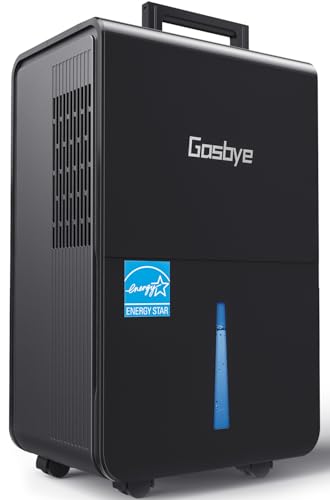
DryPrime Review Summary
If you need a dehumidifier for a large, consistently humid area, the Gasbye DryPrime is aimed squarely at that job.
The listing positions it as a 2026 Energy Star model with up to 115 pints per day, a 45 dB compressor target, a 1.7-gallon tank, and multiple drainage options, which makes it more practical than many smaller consumer units that rely on constant emptying.
It is best for buyers who want a mostly set-it-and-forget-it machine for a basement, utility room, garage, or open-plan space.
It is less appealing if you need something compact, ultra-light, or decorative.
This is a utility-first dehumidifier, and the value proposition depends on whether you actually need that level of capacity.
Review Scorecard
| Category | Score | Rationale |
|---|---|---|
| Moisture Removal Capacity | 9/10 | The listed 115 pints/day target and large-space positioning fit demanding rooms. |
| Everyday Convenience | 8/10 | Tank, hose, and garden-hose drainage options reduce emptying friction. |
| Noise Management | 7/10 | The 45 dB claim is promising for a compressor unit, though still not silent. |
| Energy Efficiency | 8/10 | Energy Star certification and the 2026 efficiency claim support lower operating waste. |
| Build and Durability | 8/10 | Reinforced copper tubing and the heavy 43-pound build suggest a sturdier design. |
| Smart Controls | 8/10 | Auto shut-off, auto restart, and humidity band control are practical for real use. |
Key Features and Specifications of DryPrime
The strongest argument for the Gasbye DryPrime is simple: it is built for larger, moisture-prone spaces rather than occasional bedroom use.
The listing says it can remove up to 115 pints per day under benchmark conditions, and its recommended use cases include basements, garages, and living rooms.
Several details make it feel more complete than a bare-bones dehumidifier.
The unit includes a 1.7-gallon tank for manual draining, a 5-foot drain hose, and a threaded outlet that can accept a standard 3/4-inch garden hose.
That matters if the machine will run often, because direct drainage is the difference between a useful appliance and a chore.
The other practical features are just as important:
- Auto shut-off and restart: the compressor stops when humidity falls 3% below the target and restarts when it rises 3% above it.
- Power-outage memory: the unit resumes previous settings after power returns.
- Residual cooling fan behavior: after compressor shutdown, the fan runs briefly to help use leftover coil cooling.
- Listed quiet operation: the compressor is marketed at around 45 dB.
- Build details: the unit is listed at 43 pounds and uses reinforced copper tubing.
- Efficiency claim: Energy Star 2026 certification is explicitly called out, along with improved efficiency versus non-Energy Star models.
From a buying perspective, the combination of capacity and drainage flexibility is the headline.
The machine is not trying to win points for portability.
It is trying to solve a damp-space problem with fewer interruptions.
Pros and Cons of DryPrime
Pros
- Strong fit for large spaces that need sustained moisture control.
- Multiple drainage paths reduce the need to empty a tank manually.
- Automatic humidity management should make operation less fiddly.
- Energy Star certification is useful for long-running use.
- The 45 dB target is a decent sign for a machine in this class.
- Copper tubing and the heavier build suggest a more durable approach than ultra-light models.
Cons
- The 43-pound weight makes it inconvenient to move often.
- The 1.7-gallon tank may still feel small if you rely on manual emptying in a very damp room.
- Buyers who only need occasional dehumidification may be paying for capacity they will not use.
- Large-room units usually need a little more space and setup planning than compact models.
The most important tradeoff is that the DryPrime is intentionally oversized for some buyers.
That is a positive if your basement truly stays damp, but it can be wasted capability in a mild climate or a small apartment.
Who Should Buy DryPrime?
This is a good match for homeowners who need to control humidity in a basement, garage, laundry area, or other large interior space.
It is also a sensible option if you prefer direct draining and do not want to babysit a tank every day.
It may also suit buyers who care about electricity use over the long run.
Energy Star certification is not a magic guarantee of low bills, but it is a meaningful signal when you expect the unit to run often.
You should probably skip it if:
- you need a lightweight unit you can carry from room to room,
- you only need dehumidification for a small bedroom or office,
- you want the smallest possible footprint,
- or you are not sure your space needs a high-capacity machine at all.
In other words, the DryPrime makes the most sense when humidity is a recurring problem, not a temporary annoyance.
How the DryPrime Handles Real-World Use
Large-Space Moisture Control
The main question with any dehumidifier like this is whether it can keep up with the room, not whether it can run.
Gasbye is clearly aiming this model at larger areas, and the listed output suggests it is built to pull moisture aggressively rather than slowly polish already-comfortable air.
Drainage and Maintenance
The best operational feature may be the drainage flexibility.
A tank works for casual use, but the included hose and garden-hose compatibility are more useful if you plan to run the dehumidifier continuously in a basement or utility space.
That is the difference between a machine you can trust and one you have to manage daily.
Noise and Placement
The 45 dB claim matters because large compressors can become background noise you never quite ignore.
This still is not a silent appliance, but the listing suggests it is intended to be tolerable in shared spaces where people may be watching TV, talking, or relaxing nearby.
Controls and Reliability
Humidity-target automation is a real quality-of-life feature.
The shut-off and restart band, plus power-loss memory, means the unit should be easier to live with over time.
Those are the kind of details that matter after the first week, when the novelty is gone and the appliance just needs to do its job.
Alternatives to DryPrime
If you want to compare before buying, look at other large-capacity Amazon dehumidifier lines that serve the same kind of space:
Those brands are worth checking because they are commonly searched in this category, and they give you a comparison set across capacity, tank size, drainage setup, and size.
If your room is smaller than the DryPrime’s target use case, a lower-capacity model may be easier to live with and cheaper to run.
Is DryPrime Worth It?
Yes, if your real need is large-space moisture control and you value drainage flexibility, efficiency claims, and automated humidity management.
The Gasbye DryPrime looks like a serious utility appliance rather than a casual household gadget.
It is not the best pick for everyone, and that is the point.
If you only need light dehumidifying, buy something smaller.
If you need a workhorse for a basement or garage, the DryPrime is the kind of model that earns its keep by reducing maintenance and staying on task.