Starting seeds indoors is easier when your tray matches the crops, space, and watering routine you actually use. The best adjustable seed starting trays offer practical control over cell size, humidity, drainage, or growing height without making setup unnecessarily complicated.
We compared 10 popular kits and reusable trays across capacity, included accessories, adjustability, and ease of use so you can choose a setup for compact windowsills, larger batches, or more controlled propagation.
Best 10 Adjustable Seed Starting Trays Picks for 2026
Best Overall

- 36 flexible silicone cells for gentler transplanting
- Drainage channels and contained watering tray
- Reusable, dishwasher-safe design with plant labeling
Best For: Gardeners who want easy watering and low-stress transplanting
Best Value Multipack

- Five reusable 17-by-10-inch plastic trays
- Raised edges contain soil and water
- Works with heat mats, domes, and hydroponics
Best For: Budget-conscious gardeners needing multiple open trays
Best Mini Greenhouse Kit

- Ten 12-cell trays provide 120 planting cells
- Adjustable vents regulate humidity and temperature
- Includes bases, domes, and plant labels
Best For: Starting many seedlings in a controlled humid environment
Best Complete Kit

- Ten 12-cell trays provide 120 total cells
- Dome lids include adjustable ventilation
- Includes shovel and scoop for planting
Best For: Indoor growers wanting a complete propagation starter set
Best Adjustable Tray Kit

- Adjustable vents and drain holes
- Six reusable trays with domes
- Compatible with heat mats
Best For: Organized, multi-tray seed starting
Best Space-Saving Option
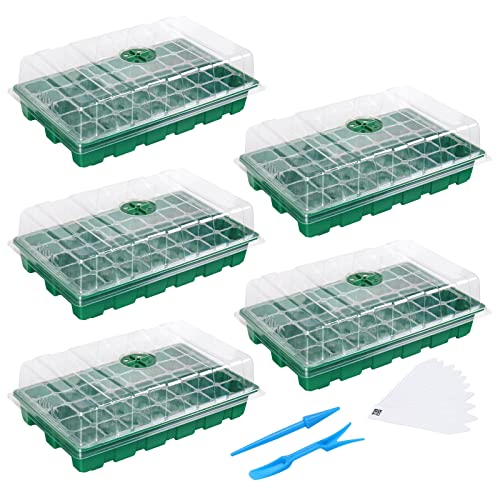
- Adjustable vents for humidity control
- Stackable bottom trays save space
- Transparent cells aid monitoring
Best For: Small-seed projects and compact setups
Best for Easy Transplanting
Silicone 60-Cell Starter Trays

- Flexible silicone bases ease removal
- Tall 5.51-inch domes add headroom
- Reusable and dishwasher-safe
Best For: Gentle transplanting and taller seedlings
Best Adjustable Lighted Set
12-Pack Seed Trays with Grow Lights

- 12 trays with 12 cells each
- Full-spectrum lights with timer
- Adjustable vents and taller domes
Best For: Large indoor propagation projects
Best Simple Multipack
Clear 5-Pack Adjustable Seed Trays

- Five 12-cell trays, 60 cells total
- Vented humidity domes and clear lids
- Reusable design with drainage holes
Best For: Beginners and small indoor growing setups
Best Self-Watering Option

- 60 cells for high-capacity propagation
- Self-watering mat supports consistent moisture
- Adjustable LED brightness, timer, and vents
Best For: Large indoor batches with less frequent watering
Best Overall – Burpee SuperSeed 36-Cell Tray
The Burpee SuperSeed is a strong choice if you want adjustable seed starting trays that make watering, labeling, and transplanting easier. Its 36 flexible silicone cells are designed for indoor vegetables, flowers, and herbs.
Best For: Gardeners who prioritize reusable construction and gentle seedling removal.
Pros:
- Flexible silicone cells pop seedlings out with less root disturbance.
- Corner drainage slots and deep watering channels help manage excess water.
- Alphanumeric rows and an included Plant-o-Gram simplify seedling identification.
- Top-shelf dishwasher safe for easier cleanup and reuse.
Cons:
- Provides 36 cells, fewer than the larger multi-pack kits.
- Designed primarily for indoor use.
Choose this tray when ease of transplanting and long-term reuse matter more than maximum planting capacity. The integrated watering features and soft cells make it especially practical for attentive indoor seed starting.
Best Value Multipack – Mr. Pen 5-Pack Seed Trays
For gardeners who need several simple adjustable seed starting trays, this five-pack offers roomy 17-by-10-inch trays for indoor or outdoor projects. The open design works for germinating seeds, growing sprouts, and handling microgreens.
Best For: Beginners and gardeners who need multiple reusable trays at a practical value.
Pros:
- Includes five sturdy plastic trays for repeated use.
- Raised edges help contain soil, fertilizer, and water.
- Lightweight and easy to clean.
- Compatible with heat mats, humidity domes, and hydroponics systems.
Cons:
- Does not include cell inserts, humidity domes, or labels.
- The large, open trays offer less individual seedling organization.
This is a straightforward option for gardeners who already have their own accessories or want flexible trays for several growing tasks. Its five-tray format is useful for scaling up without buying a single premium tray.
Best Mini Greenhouse Kit – MIXC 120-Cell Starter Set
The MIXC kit is a convenient choice among adjustable seed starting trays because each tray includes a humidity dome with adjustable vents. Ten trays, watertight bases, domes, and labels create a complete mini-greenhouse setup for indoor or outdoor seed starting.
Best For: Gardeners who want humidity control and a ready-to-use multi-tray kit.
Pros:
- Includes 10 trays with 12 cells each for 120 total cells.
- Adjustable vents help regulate humidity and temperature.
- Drainage holes support proper water management.
- Includes watertight bases, humidity domes, and plant labels.
Cons:
- Individual trays have relatively small cells and footprints.
- Plastic construction may be less flexible for root removal than silicone cells.
If you are starting many seedlings and want more environmental control, this kit offers strong convenience. The included domes and bases reduce the need to assemble a separate propagation setup.
Best Complete Kit – Mr. Pen 120-Cell Tray Set
This Mr. Pen set combines adjustable seed starting trays with transparent dome lids, ventilation controls, and basic planting tools. Ten 12-cell trays provide 120 cells, making the kit suitable for gardeners starting multiple varieties at once.
Best For: Hobby growers who want trays, humidity covers, and planting tools in one package.
Pros:
- Includes 10 trays with 120 total cells.
- Transparent domes retain moisture and adjustable vents provide ventilation.
- Drain holes help reduce overwatering and root-rot risk.
- Includes a shovel and scoop for planting and transplanting.
Cons:
- Designed for tabletop indoor use rather than large outdoor planting beds.
- Plastic cells may not offer the same flexibility as silicone trays.
This kit is a practical all-in-one starting point for indoor propagation. It stands out when you want humidity management and simple tools without sourcing each component separately.
Best Adjustable Tray Kit – VIVOSUN 72-Cell Starter Kit
For gardeners comparing adjustable seed starting trays, the VIVOSUN 6-pack combines adjustable humidity vents with a practical 72-cell layout. Drain holes help limit overwatering, while the included domes, base trays, tools, and labels make it ready for organized seed starting.
Best For: Gardeners who want multiple reusable trays for herbs, vegetables, and flowers, with humidity control and heat-mat compatibility.
Pros:
- Adjustable dome vents help manage moisture and temperature.
- Includes six trays, six base trays, six domes, tools, and labels.
- Compatible with heat mats operating from 0–120°F.
- Drain holes help protect roots from excess water.
Cons:
- The 12-cell trays may require more individual handling than larger cell-count formats.
- The supplied dimensions make each tray better suited to compact growing setups.
Its adjustable ventilation and complete accessory set make this a flexible choice for indoor seed starting. The reusable trays can also be transplanted into garden beds, raised beds, or containers.
Best Space-Saving Option – MIXC 40-Cell Seed Starter Kit
The MIXC kit is a practical option for shoppers seeking adjustable seed starting trays with small cells and stackable bottom trays. Its transparent construction makes seedlings easy to monitor, while adjustable dome vents provide control over humidity and temperature.
Best For: Indoor or outdoor growers starting small seeds in a compact setup where storage space matters.
Pros:
- Adjustable humidity-dome vents help regulate the growing environment.
- Transparent plastic makes it easy to observe plant progress.
- Bottom trays can be stacked before germination to save space.
- Includes five seed trays, bottom trays, domes, tools, and labels.
Cons:
- The 1.5-by-1.5-by-2-inch cells are intended for small seeds.
- Each set provides 40 cells, fewer than some higher-capacity starter kits.
With stackable bases and adjustable vents, this kit suits gardeners who need a manageable propagation station without sacrificing visibility. Check the listed cell and dome dimensions to ensure they fit your seedlings and available space.
Best for Easy Transplanting – Silicone 60-Cell Starter Trays
These adjustable seed starting trays stand out for their tall 5.51-inch humidity domes and flexible silicone cell bottoms. The added height accommodates developing seedlings, while the adjustable vent helps fine-tune humidity and temperature during germination.
Best For: Growers who prioritize gentle seedling removal, extra vertical room, and reusable equipment for indoor or outdoor sowing.
Pros:
- Tall domes provide additional vertical space for seedlings.
- Flexible silicone bottoms help release seedlings with intact roots.
- Dual drainage holes and grooved bases help direct excess water away.
- Includes five 12-cell trays, domes, base trays, labels, and tools.
Cons:
- Heat mats and grow lights are compatible but not included.
- The flexible silicone construction may feel less rigid than standard plastic trays.
This kit is especially useful when transplant damage is a concern. Its reusable, dishwasher-safe trays and tall domes add convenience for repeated growing cycles, while the drainage design supports better moisture management.
Best Adjustable Lighted Set – 12-Pack Seed Trays with Grow Lights
This 12-pack is a versatile option for gardeners who want adjustable seed starting trays with built-in lighting and humidity control. Each tray has 12 cells, a taller dome, drainage holes, and an adjustable vent window, while the included timer helps automate the grow lights.
Best For: Indoor gardeners starting multiple varieties of flowers, vegetables, fruits, or cuttings under controlled lighting.
Pros:
- Includes 12 trays with 12 cells each for a large propagation setup.
- Full-spectrum eight-LED grow lights provide supplemental indoor lighting.
- Adjustable humidity window and taller lids offer more control and room for early growth.
- Three-, six-, and 12-hour timer settings reduce daily light-management tasks.
Cons:
- The USB power adapter is not included and requires a 5V adapter.
- The larger set may be more than needed for small-scale seed starting.
Choose this kit if you need quantity, integrated lights, and adjustable humidity in one package. It is especially practical for indoor growers managing several plant types at once.
Best Simple Multipack – Clear 5-Pack Adjustable Seed Trays
These clear adjustable seed starting trays provide a straightforward setup for indoor germination. The five-pack includes 12-cell trays, matching bases, vented humidity domes, and labels, making it easy to monitor seedlings while managing moisture without built-in electronics.
Best For: Beginners, classrooms, windowsills, and gardeners who already have a grow light or adequate natural light.
Pros:
- Five complete trays provide 60 total cells for organized sowing.
- Adjustable dome vents help regulate humidity and temperature.
- Clear construction makes root and seedling development easier to observe.
- Drainage holes help reduce excess water, and the lightweight plastic is reusable.
Cons:
- No grow light or automated timer is included.
- The 12-cell format offers less room for larger plants than a larger-cell tray.
This is a practical, budget-conscious choice when you want adjustable humidity and multiple trays without paying for lighting features. Pair it with a suitable light source for indoor growing.
Best Self-Watering Option – 60-Cell Tray with Grow Light
This 60-cell adjustable seed starting tray combines self-watering with integrated grow lights and humidity controls. Its capillary mat supports more consistent moisture, while the two adjustable vents, enlarged drainage holes, and adjustable light brightness help tailor conditions across the seedling stages.
Best For: Gardeners who want high capacity with automated moisture support and adjustable indoor lighting.
Pros:
- Large 60-cell tray supports substantial seed-starting batches.
- Self-watering system and capillary mat help maintain consistent moisture.
- Two LED strips offer adjustable brightness and timer functions.
- 4.07-inch dome, adjustable vents, and enlarged drainage holes support airflow and early growth.
Cons:
- It is a single large setup rather than several separate trays.
- The 16.6-by-11-inch footprint requires more indoor space.
For gardeners prioritizing capacity and reduced watering chores, this is the most feature-rich option of the three. Its larger footprint and integrated system make it better suited to a dedicated indoor growing area.
How We Picked These Adjustable Seed Starting Trays
We focused on features that affect real indoor growing results: cell count and size, tray dimensions, drainage, humidity-dome design, reusability, watering options, and compatibility with grow lights. Kits that include bases, domes, lighting, timers, or self-watering features can simplify setup, while basic trays may be better for gardeners who already own propagation equipment.
Because “adjustable” can mean different things, we considered more than movable cell inserts. Height-adjustable domes, controllable humidity, flexible silicone construction, expandable kits, and integrated lighting all add useful control during germination and early seedling growth.
Quick Comparison
| Best For | Look For |
|---|---|
| Small batches | Compact trays with fewer, larger cells |
| Many seedlings | High cell counts and stackable or modular sets |
| Humidity control | Clear domes with adjustable vents or height |
| Easy watering | Base trays, drainage holes, or self-watering designs |
| Indoor shelves | Low-profile dimensions and compatible grow lights |
| Repeated use | Durable plastic or flexible silicone construction |
Key Buying Factors for Adjustable Seed Starting Trays
Cell Size and Plant Type
Small cells maximize seedling numbers but dry out faster and may require earlier transplanting. Larger cells hold more mix and suit seedlings that need extra root space. Check whether the tray supports the crops you grow most often rather than choosing solely by total cell count.
Humidity and Dome Adjustability
A dome helps retain moisture during germination, but seedlings need increasing airflow as they develop. Adjustable vents or a heightened dome make it easier to reduce condensation and accommodate taller plants. Remove the dome once seedlings are established and require stronger air circulation.
Watering and Drainage
Drainage holes help prevent saturated mix and root problems, while a base tray catches runoff. Self-watering designs can reduce daily attention, but they still need monitoring because consistently wet media is not ideal for every crop.
Lighting, Footprint, and Reuse
If you lack a bright window, an included grow light and timer may be worth prioritizing. Measure your shelf before buying, especially for kits with domes. For repeated seasons, favor sturdy trays that clean easily and resist cracking; silicone options can be convenient to release seedlings, though they may need more support when moved.
Who Should Buy Which Adjustable Seed Starting Trays?
Choose a compact, lower-cell tray if you are testing a few varieties or have limited windowsill space. High-capacity multi-packs are better for vegetable starts, flowers, and succession planting. Gardeners who frequently forget to water should consider self-watering bases, while anyone growing in a cool or dim room may benefit from a kit with a grow light and timer.
For the most flexibility, prioritize adjustable domes, dependable drainage, and cell dimensions suited to your plants. If you already own lights and humidity equipment, a simple reusable tray may deliver better value than an all-in-one kit. Before ordering, confirm the listed dimensions, included pieces, and whether the tray is compatible with your growing shelf or light setup.